


Boxed vs Walmart for Bulk Shopping: Which Saves More?
Table of Contents
- Boxed vs Walmart for Bulk Shopping: The Core Differences
- Is Buying in Bulk Actually Cheaper?
- Price Comparison: Household Essentials and Perishables
- Membership Fees and Hidden Costs
- Best Online Alternatives to Walmart for Bulk Shopping
- How to Save Money on Household Essentials
- Storage, Food Waste, and Real Savings
- Which Option Works Best for Your Household
- Frequently Asked Questions
Last Updated: September 2, 2026
Boxed vs Walmart for Bulk Shopping: The Core Differences
Boxed operates as a membership-based online warehouse club focused exclusively on bulk quantities and pricing. Walmart is a traditional retailer offering bulk options alongside standard retail quantities across thousands of physical and online locations.
Boxed requires a $49 annual membership and operates exclusively online with delivery-only fulfillment (boxed.com). Walmart offers both in-store and online shopping with no membership required for standard shopping, though Walmart+ ($98 annually) adds paid delivery options.
The core question isn't which retailer has lower per-unit prices. It's whether the membership fee, delivery costs, storage logistics, and food waste risk offset the savings on items you actually buy regularly. Most households find that one model works dramatically better once you account for these hidden variables.
Is Buying in Bulk Actually Cheaper?
Buying in bulk is cheaper on a per-unit basis, but that's not the same as cheaper overall. The unit price advantage is real, but genuine savings depend on three factors most people ignore: membership costs, storage capacity, and food waste.
If you purchase enough bulk items annually to offset membership and delivery costs, then yes, bulk buying saves money. Many households find that buying non-perishable essentials in bulk delivers genuine savings. Paper products, cleaning supplies, canned goods, and shelf-stable pantry items are where bulk purchasing makes the most sense.
Fresh produce and perishable goods are where bulk shopping often backfires. A 10-pound bag of potatoes might cost less per pound than buying three pounds at Walmart. But if you live alone or your household doesn't consume potatoes quickly, you're paying a lower unit price for food that spoils before you eat it. The effective cost becomes much higher.
The math shifts based on household size and consumption patterns. A family of five buying bulk staples they use weekly will see clear savings. A single person buying bulk produce they can't finish will see savings evaporate as waste.
Price Comparison: Household Essentials and Perishables
Non-Perishable Items
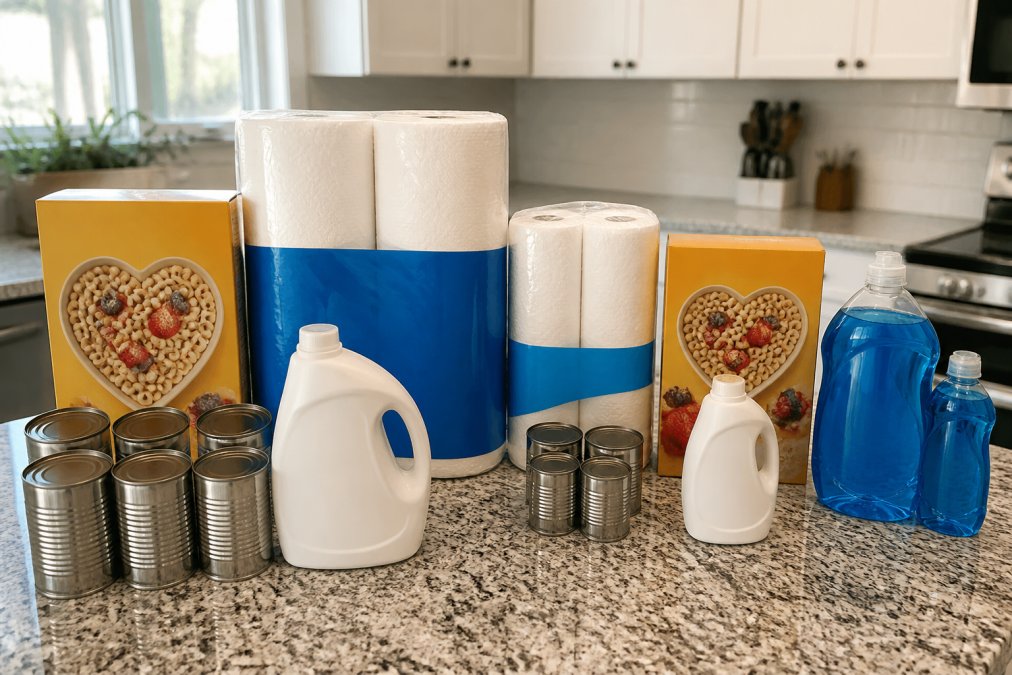
Non-perishable items deliver the clearest bulk shopping value. Paper products, cleaning supplies, canned vegetables, pasta, rice, and shelf-stable pantry items rarely spoil, so per-unit savings translate directly to household savings.
For household essentials like paper towels, toilet paper, and trash bags, bulk purchasing can offer savings compared to standard retail pricing (the FTC). A case of paper towels at Boxed may cost less per roll than individual packages at Walmart. Canned goods, pasta, rice, and dried beans follow the same pattern.
The key variable is consumption velocity. If you're buying items you'll actually use before they expire, bulk pricing on non-perishables is a straightforward win.
Fresh Produce and Perishable Goods
Fresh produce and perishable goods are where bulk shopping breaks down for many households. Boxed offers some fresh items in bulk quantities designed for larger families or meal-prep operations.
A case of berries might contain three times a standard retail package. If your household consumes that volume before spoilage, you've saved money. If half the berries mold before you eat them, you've paid extra for waste. The per-pound savings disappear when you factor in spoilage.
Walmart's advantage is flexibility. You can buy exactly the quantity you need without committing to bulk. One head of lettuce, two pounds of chicken, a single bag of salad. This flexibility costs more per unit but eliminates waste risk for households that can't consume bulk quantities quickly.
For perishable goods, real savings come from meal planning and consumption patterns, not the retailer. A household that plans meals around bulk purchases and has storage space can make bulk perishables work. A household that shops spontaneously or has limited refrigerator space will see better results with smaller, more frequent Walmart purchases.
Membership Fees and Hidden Costs
Boxed charges a $49 annual membership fee. Walmart offers standard shopping without membership, though Walmart+ ($98 annually or $12.98 monthly) provides faster delivery without necessarily lowering unit prices.
For Boxed, you need to save at least $49 per year on bulk purchases to break even. For a household buying paper products, cleaning supplies, and shelf-stable pantry items regularly, this breakeven point can often be reached within the first few months.
Walmart+ membership adds convenience and speed, not bulk savings. If you're comparing Boxed vs Walmart for bulk shopping specifically, standard Walmart.com offers bulk quantities without membership.
Delivery fees also matter. Boxed includes free delivery on orders over a threshold (typically $35-50). Walmart charges delivery fees unless you have Walmart+ membership. For regular bulk shopping, delivery costs accumulate.
Storage space is an underestimated hidden cost. Bulk items require room. If you live in a small apartment or have limited pantry space, bulk shopping creates a storage problem. You're paying a lower per-unit price but using home space that could hold other items. For households with adequate storage, this cost is negligible. For small-space dwellers, it's substantial.
Best Online Alternatives to Walmart for Bulk Shopping
Beyond Boxed, several online retailers offer bulk shopping options.
Amazon Subscribe & Save provides discounts on regularly-delivered non-perishables with no membership fee and no storage risk for perishables. Savings are typically smaller than Boxed.
Instacart connects you with local grocery stores for bulk purchases, but prices are generally higher than dedicated bulk retailers. You're paying for convenience and selection, not bulk savings.
Thrive Market operates as a membership-based online retailer ($60 annually) focused on organic and specialty products (thrivemarket.com). If your household prioritizes organic products, Thrive's bulk options might justify membership. For price-focused bulk shopping, Boxed typically offers better savings.
Costco operates physical warehouse clubs with strong in-store bulk shopping, but doesn't offer strong online bulk options. Membership costs $60-130 annually depending on tier.
Boxed and Walmart represent the two dominant online bulk shopping models. Boxed is optimized for pure bulk savings with membership-based pricing. Walmart offers flexibility and selection without required membership.
How to Save Money on Household Essentials
The biggest opportunity to save money on household essentials isn't choosing between retailers, it's understanding what you actually buy and buying accordingly.
Track your household essentials spending for one month. Note what you buy, how often, and quantities. This reveals your true consumption patterns and prevents bulk purchases that result in waste.
Focus bulk purchases on items with the longest shelf life and highest consumption velocity. Paper products, cleaning supplies, and non-perishable pantry staples are ideal. A household buying 50 rolls of paper towels per year may save more money buying in bulk than a household buying 12 rolls per year.
For perishable goods, bulk shopping works only with a meal plan and consumption strategy. Don't buy bulk berries if you typically eat fresh fruit sporadically.
Compare your actual household budget against membership fees and delivery costs. If you spend $500 monthly on groceries, a $49 annual Boxed membership is negligible. If you spend $200 monthly, the membership fee is a larger percentage and must be justified by higher savings.
Storage, Food Waste, and Real Savings
The gap between per-unit savings and actual household savings is storage and food waste.
Bulk items require storage space. A case of 30 rolls of paper towels takes up shelf or closet space. For small apartments, this storage cost is real. For houses with basements, garages, or large pantries, storage can be free and abundant.
Food waste is the silent savings killer. A bulk purchase of berries lasting two weeks costs less per ounce than buying smaller quantities weekly. But if one-third spoil before you eat them, your effective cost per ounce is higher than buying smaller quantities more frequently.

Calculate your actual food waste rate. Track how much food you throw away each week. If you're discarding 10-15% of purchases, your bulk savings are partially offset by waste. If you're discarding less than 5%, bulk shopping is working efficiently.
For households with adequate storage space, regular consumption patterns, and low food waste rates, bulk shopping delivers genuine savings. For households with limited storage, variable consumption, or high waste rates, smaller, more frequent Walmart purchases often result in lower effective costs.
Which Option Works Best for Your Household
The answer depends on four household variables: consumption patterns, storage capacity, household size, and shopping frequency.
Boxed works best for:
- Households with consistent, high-volume consumption of non-perishables
- Families of 4+ that use bulk items regularly
- Households with adequate storage space
- Shoppers who prefer online ordering and home delivery
- Budgets where the $49 annual membership fee is easily offset by savings
Walmart works best for:
- Households with variable or unpredictable consumption patterns
- Smaller households (1-2 people) buying smaller quantities
- Shoppers who value flexibility and don't want to commit to bulk quantities
- Households with limited storage space
- Shoppers who prefer the option to browse in-store or buy exactly what they need
If you're buying the same non-perishable items weekly and your household size justifies bulk quantities, Boxed membership can pay for itself quickly. If you're buying sporadically or your household can't consume bulk quantities before spoilage, Walmart's flexibility makes more sense.
The most cost-effective approach for many households is a hybrid: use Boxed for non-perishable essentials you buy consistently, and use Walmart for fresh produce, proteins, and items you buy spontaneously. This captures bulk savings where they're most effective while avoiding waste risk on perishables.
Track your actual spending for one month at your current retailer. Then calculate what you'd spend at each alternative, including membership fees and delivery costs. The math will tell you which option saves more money for your specific household.
Choosing between bulk shopping options comes down to one question: does the savings justify the membership cost, delivery fees, and storage commitment? For most households buying consistent quantities of non-perishables, Boxed can deliver clear savings. For households with limited storage or variable consumption, Walmart's flexibility often wins. The best solution is the one that actually fits your household's real shopping patterns and lifestyle, not the one with the lowest per-unit price on paper.
Frequently Asked Questions
Q: Is buying in bulk actually cheaper for small households?
A: Bulk purchasing saves money on per-unit costs, but only if you consume the items before they spoil or expire. Small households often waste perishable goods, eliminating savings. Non-perishable items like paper products, cleaning supplies, and shelf-stable groceries offer genuine savings. Calculate your household consumption rate and storage capacity before committing to bulk quantities. Compare the per-ounce or per-unit price against regular retail prices, accounting for membership fees and delivery costs.
Q: Does Boxed charge a membership fee like other warehouse clubs?
A: Boxed operates as a membership-based online bulk retailer with annual subscription fees, similar to traditional warehouse clubs. The membership cost affects your total savings calculation. You need to compare the annual fee against the per-unit savings on items you actually purchase regularly. Some households break even on membership within a few months if they buy enough bulk items; others may not see a return on investment if their shopping habits are minimal or sporadic.
Q: What hidden costs should I account for when comparing Boxed and Walmart bulk shopping?
A: Beyond purchase price, factor in delivery fees, subscription costs, minimum order requirements, and food waste. Walmart's bulk selection varies by location and may require in-store shopping. Boxed charges delivery fees that vary by order size and location. Both platforms may have price markups on certain items. Account for storage space, spoilage risk on perishables, and whether you'll actually use everything before expiration. These hidden costs often determine which option delivers real savings for your household budget.
Q: How do I know which bulk shopping option will actually save me money?
A: Track your current spending on household essentials for one month. Identify which items you buy repeatedly and in what quantities. Compare the per-pound cost or per-ounce price of those specific items across Boxed and Walmart, then subtract membership fees and delivery charges. Consider your household size, consumption rate, and available storage. Small households with limited storage often save more with Walmart's in-store bulk selection, while larger families may benefit from Boxed's convenience and lower per-unit prices on high-volume items.
This article was written using GrandRanker