


How to Verify Online Product Quality: 7 Steps
Table of Contents
- What You'll Need Before You Start Verifying Online Product Quality
- Step 1: How to Check If an Online Store Is Legit
- Step 2: How to Spot Fake Online Reviews Before You Buy
- Step 3: Analyze Product Photos and Descriptions for Authenticity
- Step 4: Verify Online Product Quality Using Omnichannel Signals
- Step 5: Tips for Avoiding Online Shopping Scams
- Step 6: Physically Inspect Products Upon Delivery
- Common Mistakes to Avoid When Checking Product Quality Online
Last Updated: August 18, 2026
What You'll Need Before You Start Verifying Online Product Quality
Knowing how to verify online product quality before clicking "buy" is one of the most practical skills any shopper can develop. At Value Market Plus, we've helped thousands of customers shop with confidence, and the questions we hear most often come down to the same core concern: how do I know what I'm getting is actually what's advertised?
The good news is that verification doesn't require technical expertise. It requires a consistent framework applied before, during, and after purchase. Below, we'll walk you through exactly that framework in seven steps, including angles most shopping guides skip entirely.
Before you start, gather these basics:
- A device with a browser that supports reverse image search
- The product URL and seller name
- Any screenshots of the listing (prices and descriptions sometimes change after you've viewed them)
- A few minutes to cross-check reviews across multiple platforms
The FTC's guidance on online shopping is also worth bookmarking. It outlines your rights as a consumer and what to do when a purchase goes wrong.
| Verification Stage | What to Check | Time Required |
|---|---|---|
| Before purchase | Store legitimacy, reviews, product photos | 5-10 minutes |
| During research | Omnichannel signals, return policy | 3-5 minutes |
| Upon delivery | Physical inspection, material quality | 2-3 minutes |
Step 1: How to Check If an Online Store Is Legit
Checking whether an online store is legitimate is the first line of defense against scams and low-quality products. A store's credibility determines whether any product claim it makes is worth trusting.
Look for Trust Signals and Secure Payment Indicators
Start with the basics. A legitimate store will display:
- HTTPS in the URL bar with a padlock icon (this confirms the connection is encrypted)
- Recognizable, secure payment options at checkout
- A physical address and working contact information
- Clear return and refund policies written in plain language
Missing any of these is a red flag, not a minor oversight. Scam sites routinely omit contact details or bury their return terms in confusing language designed to discourage claims.
Verify the Store's Digital Footprint and Brand Consistency
A store's digital footprint tells you more than its homepage does. Search the store name plus words like "reviews," "scam," or "complaints." Check whether the business has a consistent presence across social media platforms. Brand consistency matters: legitimate retailers maintain the same logo, tone, and contact details everywhere they appear.
Look at the domain registration age using a free WHOIS lookup tool. Sites registered within the last few months selling heavily discounted electronics or luxury goods are disproportionately likely to be fraudulent. A thin digital footprint combined with aggressive discounting is one of the clearest patterns in e-commerce scam detection.
Step 2: How to Spot Fake Online Reviews Before You Buy
Fake reviews are the single biggest obstacle to verifying product quality online. Spotting them requires looking past the star rating and examining the actual structure and content of the feedback.
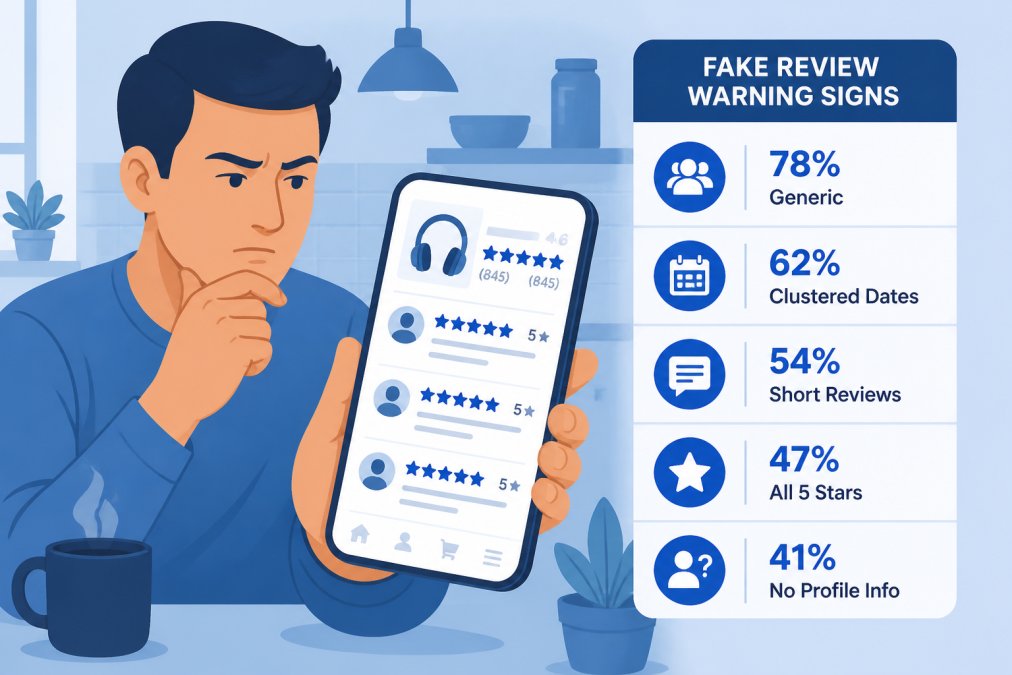
The first thing to check is review distribution. Authentic products tend to have a natural spread: a mix of five-star, four-star, three-star, and occasional lower ratings. A product with thousands of five-star ratings and almost nothing else is statistically unusual. Real customer feedback is messy.
Detect AI-Generated Reviews With These Patterns
AI-generated reviews are increasingly common and harder to spot than manually written fakes. Look for these patterns:
- Vague praise without specifics: "Great product, very happy!" tells you nothing about the actual item
- Unusual sentence rhythm: overly formal phrasing mixed with generic enthusiasm
- No mention of delivery, packaging, or real-world use: authentic reviewers typically describe their actual experience
- Identical phrases across multiple reviews: copy-paste patterns across dozens of listings
Tools like the Fakespot review analysis tool can automate much of this analysis, grading sellers based on review authenticity signals. Run any high-ticket purchase through it before committing.
Cross-Reference Reviews With Independent Consumer Advocacy Groups
Verified purchase badges matter, but they're not infallible. Cross-reference product feedback with independent consumer advocacy organizations. The Consumer Reports product testing and reviews database covers thousands of product categories with independent testing that no seller can influence.
For niche products, look for subreddits, forums, or user communities where real owners discuss long-term durability and material quality. These conversations are harder to fake than platform reviews because they're ongoing and interactive.
Step 3: Analyze Product Photos and Descriptions for Authenticity
Most product authenticity problems announce themselves in the imagery, if you know what to look for.
Reverse image search every hero photo. Right-click any product image and run it through a reverse image search. If the same photo appears on dozens of unrelated sites or under different product names, the seller likely sourced it from a stock library or copied it from another listing. That's a strong signal the actual product may look nothing like the photo.
Authentic product imagery tends to show:
- Multiple angles including the back, bottom, and interior
- Real-world scale references (a hand, a common object nearby)
- Slightly imperfect lighting, which indicates original photography
- Unboxing or in-use shots from real customers
Product descriptions deserve equal scrutiny. Authentic descriptions include specific material quality details, dimensions in precise measurements, and care or usage instructions. Vague descriptions like "high quality material" or "premium feel" without specifics are a common pattern in low-quality or counterfeit listings.
Watch for translation artifacts too. Awkward phrasing, inconsistent capitalization, and unusual punctuation often indicate a description written in another language and machine-translated, which correlates with drop-shipped products that may not match their listings.
Step 4: Verify Online Product Quality Using Omnichannel Signals
Omnichannel signals are the cross-platform consistency checks that reveal whether a brand's quality claims hold up beyond its own storefront. This is where most shoppers stop short, and where the biggest verification gains are available.
Search for the product or brand on social media platforms. User-generated content (unboxing videos, real-world use clips, honest photo comparisons) is much harder to fake than written reviews. If a product has genuine fans, they leave a trail.
Check whether the brand's customer support is reachable before you need it. Send a pre-purchase question and note the response time and quality. A brand that answers promptly and specifically before the sale is far more likely to support you after it. A brand that ignores pre-sale inquiries or responds with scripted non-answers will almost certainly be worse when something goes wrong.
Also verify the return policy and warranty terms in full before purchasing. A clear, simple refund policy is a transparency signal: it means the brand is confident enough in its product quality to back it. Vague or punitive return terms, short warranty windows, or "all sales final" language on non-perishable goods are red flags worth heeding.
Step 5: Tips for Avoiding Online Shopping Scams
The most effective tips for avoiding online shopping scams aren't about being paranoid. They're about being systematic.
Never pay by wire transfer or gift card. These payment methods offer no consumer protection. Legitimate e-commerce stores accept credit cards or established payment processors, which give you recourse if something goes wrong.
Be skeptical of urgency tactics. "Only 2 left!" or countdown timers that reset every time you visit the page are pressure tactics designed to short-circuit your verification process. Genuine scarcity doesn't need a flashing banner.
Check the URL carefully at checkout. Scam sites sometimes mimic legitimate retailers with near-identical URLs (think "amaz0n" or "bestbuy-deals"). Verify you're on the correct domain before entering any payment information.
Additional protective habits:
- Use a credit card rather than a debit card for e-commerce purchases (credit cards offer stronger fraud protection under the Fair Credit Billing Act)
- Enable purchase notifications from your bank
- Screenshot your order confirmation and any listed product specifications before the page changes
- Save all communication with the seller
Step 6: Physically Inspect Products Upon Delivery
Physical inspection upon delivery is the step that converts online quality claims into real-world verification. Most guides treat this as an afterthought. It shouldn't be.

Open every package promptly and inspect it before discarding packaging materials. The unboxing experience itself carries information: legitimate quality products from reputable brands typically arrive in clean, intact packaging with consistent branding. Damaged, resealed, or mismatched packaging warrants immediate attention.
Run through this physical inspection checklist upon delivery:
- Does the product match the listed dimensions and weight?
- Are seams, joints, or connections finished cleanly with no rough edges?
- Do moving parts operate smoothly without grinding or resistance?
- Does the material quality match what was described (texture, weight, finish)?
- Are labels, serial numbers, or certification marks present and legible?
- Is there a warranty card or documentation included?
- Does the product smell unusual (chemical odors can indicate low-quality materials)?
Document any discrepancy with photos immediately. Most consumer protection processes, including credit card chargebacks and retailer return claims, are significantly easier to resolve when you have timestamped photographic evidence.
If a product fails this inspection, initiate the return process the same day. Waiting reduces your options under most return windows and some consumer protection frameworks.
Common Mistakes to Avoid When Checking Product Quality Online
The biggest mistake shoppers make is treating review-checking as the whole verification process. Reviews are one input, not a complete picture. A product can have strong social proof and still disappoint if you haven't checked material quality specifications, seller credibility, or the return policy.
Here are the patterns that consistently lead to bad purchases:
Trusting aggregate star ratings without reading the reviews. A 4.7-star rating built on thousands of vague five-star reviews is less meaningful than a 4.2-star rating with detailed, specific feedback about durability and real-world performance.
Skipping the return policy check. Many shoppers only look at this after something goes wrong. By then, the 30-day window may have closed or the conditions may be more restrictive than expected. Read it before you buy.
Ignoring the seller, focusing only on the product. On marketplace platforms, the same product listing can be fulfilled by multiple third-party sellers with wildly different quality assurance standards. Seller reputation matters as much as product ratings.
Not using reverse image search. This takes 15 seconds and can save you from purchasing a product whose photos were lifted from a completely different item.
Assuming a high price signals high quality. Price and quality are loosely correlated at best in online retail. Verification steps matter equally at every price point.
Value Market Plus addresses several of these concerns directly: every product in the catalog has been tested before listing, customer support connects you to real people (not automated systems), and the return policy is written to be clear and straightforward. For shoppers who've been burned by vague quality claims elsewhere, that combination of quality assurance and transparent policies is a meaningful difference.
For broader consumer protection guidance, the USA.gov guide to online shopping safety outlines your rights and the steps to take when a purchase doesn't go as expected.
Verifying product quality online takes a few extra minutes upfront, but it consistently prevents the frustration of receiving something that doesn't match what was advertised. Value Market Plus was built around the principle that shoppers shouldn't have to do extensive detective work to trust what they're buying. With tested products, real customer support, and a clear refund policy, the goal is to make verification straightforward. Shop Now and see the difference a curated, quality-assured selection makes.
Frequently Asked Questions
How do I check the quality of a product before buying online?
Start by reading verified purchase reviews, not just overall star ratings. Check the review distribution, a healthy product has a mix of ratings, not only five-star feedback. Look at product specifications carefully, run a reverse image search on the photos to confirm they're original, and check whether the seller has a transparent return policy and real customer support. Cross-referencing with independent consumer advocacy sites adds another layer of confidence before you commit to buying.
How can I tell if an online product description is accurate?
Accurate product descriptions include specific material quality details, exact dimensions, and clear warranty terms. Be cautious when descriptions use vague language like 'premium' or 'high-quality' without backing it up with specs. Compare the description against user-generated content such as customer photos and unboxing videos. If the product imagery looks professionally staged but lacks real-world shots, that's a red flag worth investigating before purchasing.
What are the red flags of a fake online store?
Common red flags include no verifiable business address, missing or vague return and refund policies, prices that seem unrealistically low, and no accessible customer support beyond a generic contact form. Stores without secure payment options (look for HTTPS and recognized payment processors) should raise immediate concern. Thin or missing social proof, brand consistency issues across pages, and recently registered domains are additional warning signs that a store may not be legitimate.
Are there tools to verify the authenticity of a brand or product online?
Yes. Google's reverse image search helps confirm whether product photos are original or copied from other sources. The Better Business Bureau (BBB) database lets you check a seller's complaint history and accreditation status. The FTC's consumer protection resources outline your rights when a purchase goes wrong. For reviews, look for platforms that label 'verified purchase' badges, and check third-party review aggregators to see whether sentiment analysis across multiple sources aligns.
This article was written using GrandRanker